
Quick answer: define the DC duty before choosing equipment
Start with the circuits that must operate when the station AC supply is unavailable. Record their voltage limits, continuous demand, short-duration operating loads and required sequence. Then agree the backup duty, battery and charger responsibilities, distribution scope and evidence needed for technical acceptance.
A useful RFQ contains a single-line diagram, a DC load schedule and a supply-boundary list. A nominal voltage, a battery Ah figure or a charger current alone cannot define a complete substation DC power system. Use the three tables below to collect information and identify decisions that still belong with the project engineer.
Define what the station DC system must support
Operating DC supplies switching, protection and control functions. Depending on the station design, loads can include protection relays, control circuits, breaker trip and close coils, indication and selected communication equipment. Identify the actual circuits on the drawings; do not assume every auxiliary load belongs on the same DC bus.
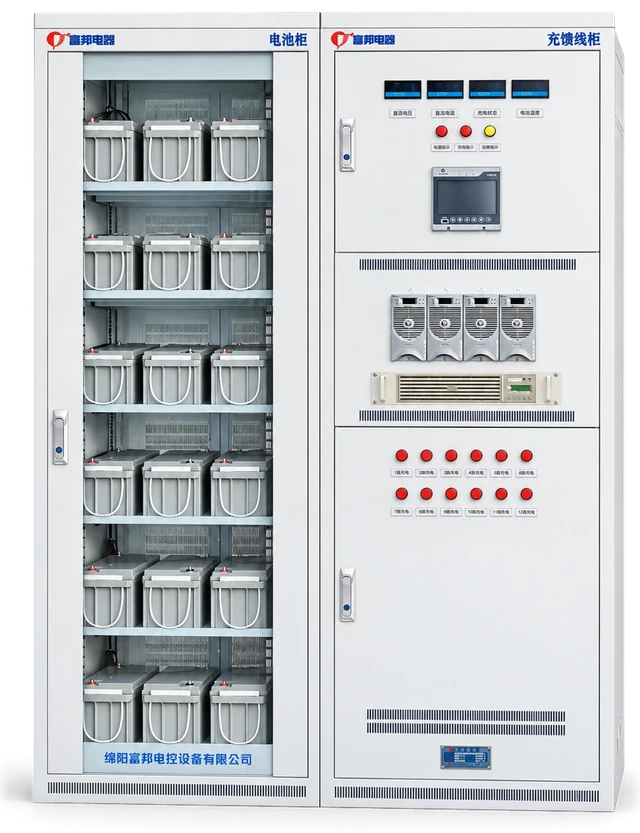
In a battery-backed arrangement, the charger/rectifier converts AC to DC, supplies the applicable standing loads and maintains the battery. The battery supports the agreed duty when AC or charger supply is unavailable. Distribution and protective devices connect these sources to the load groups. Monitoring reports the conditions defined for the system; its presence does not establish every alarm or communication function.
For a retrofit, draw the boundary between retained and new equipment. Record the existing battery, charger, bus arrangement, feeder protection and alarm interfaces. A replacement charger must be reviewed against those interfaces, even if its nameplate voltage matches the old unit.
Charger only or a complete DC power system?
Choose the procurement scope around what the project already has and who will integrate it. “Complete system” should describe an agreed bill of materials and responsibilities, not an assumption that every component below is included.
| Scope item | Charger-only enquiry | System enquiry: agree explicitly |
|---|---|---|
| AC/DC conversion | Define the charger duty and compatibility with the retained DC arrangement. | Specify charger/rectifier arrangement, AC inputs, control and maintenance conditions. |
| Battery | Provide retained battery data and the party responsible for its condition and suitability. | State whether the battery is supplier-provided, owner-provided or excluded; agree sizing and accommodation. |
| DC feeders | Identify existing distribution and interfaces needing alteration. | Agree outgoing circuits, protection, terminals, spare ways and cable boundaries. |
| Monitoring | List required charger signals and interfaces to the existing system. | Agree battery, bus, feeder and insulation monitoring scope, alarms and supervisory interfaces. |
| Cabinets and connections | Confirm mounting, access, cable entry and connection responsibilities. | Define cabinets or racks, internal connections and any site interconnection work. |
| Documents and acceptance | Request equipment data and the agreed interface checks. | Allocate calculations, drawings, inspection, testing, site work and acceptance responsibilities. |
On a small screen, scroll inside the table to compare all columns.
Ask each bidder to mark every item as included, excluded, supplied by others or awaiting confirmation. Resolve qualifications before comparing price. Batteries, site cabling, installation and commissioning are not automatically included with a GZG10 quotation.
Build a DC load schedule that engineering can use
Record continuous demand separately from equipment that operates for a limited interval. Give trip and close coils separate entries: their currents, timing and operating requirements can differ. Where a mechanism has a motor or another auxiliary load, first confirm its actual supply circuit rather than assuming it is DC-fed.
The template deliberately leaves electrical values unfilled. Duplicate rows for each device or identical load group, state quantities and identify the document revision behind each value. Mark missing data as “to be confirmed”; an empty value must not be interpreted as zero load.
| Equipment / tag / quantity | Load type | Voltage and limits | Current data | Duration / sequence | Simultaneous operation | Data source / status |
|---|---|---|---|---|---|---|
| Protection or control device: enter tag and quantity | Continuous, if energised throughout the duty | Enter rated and permitted terminal range | Enter standing demand and relevant peaks | Identify required operating period | List devices energised together | Device datasheet; revision; confirmed / pending |
| Breaker trip coil: enter device and coil identification | Short-duration operating load | Enter coil rating and operating limits | Enter trip current or documented burden | Record pulse duration, repetition and timing | Identify required simultaneous trips | Breaker data and protection philosophy; status |
| Breaker close coil: enter device and coil identification | Short-duration operating load | Enter coil rating and operating limits | Enter closing current or documented burden | Record closing sequence and repeats | Identify concurrent and sequential actions | Breaker data and switching procedure; status |
| Other confirmed DC load: enter tag and quantity | Continuous or intermittent; state which | Enter the actual supply requirement | Separate running and starting demand, if relevant | Record on-time and position in the duty | State overlap with other loads | Equipment data / measurement / design document; status |
Scroll horizontally for voltage, current, timing and evidence columns. This is an input template, not a calculated load schedule.
Record whether a value is per device or the total for the stated quantity. If a datasheet gives watts rather than amperes, retain its original unit and voltage basis for engineering conversion. Do not add a nameplate maximum to a measured load without recording what each value represents.
Agree autonomy, operating sequence and voltage limits
A load list becomes a design input when the project also defines when each load operates. Agree the required backup period, operations at loss of AC, operations during the outage and actions needed for restoration. Identify simultaneous operations and any uncertain timing for engineering assessment. Western Power's public design reference illustrates this distinction between a load inventory and a duty cycle; its utility-specific durations are not adopted here.
For a 110 VDC or 220 VDC proposal, request the permitted voltage range at each critical load, including breaker coils. Review the highest charging condition, end-of-discharge condition and voltage drop through cables and connections. Nominal bus voltage is not the voltage guaranteed at a remote load terminal.
The design review should therefore establish the battery arrangement, charging limits, minimum terminal voltage and cable/protection interfaces together. Supply the cable route and existing DC earthing arrangement where known. Do not select between 110 and 220 VDC from a cabinet name or assume that the choice establishes Malaysian project acceptance.
Review battery capacity, charger duty and redundancy together
Battery capacity starts with a defined duty
Ask for a calculation using the proposed battery's discharge data, the agreed duty profile, end voltage and site temperature. State the project's ageing and design-margin criteria rather than inserting an unexplained percentage. The SP Energy Networks reference also demonstrates why discharge characteristics must match the selected cell or monobloc; its numerical design rules are specific to its network.
An Ah label is not, by itself, proof that short operating loads and the required backup period will be supported. Record the selected chemistry, cell arrangement, rating basis and calculation assumptions so the responsible engineer can review the proposal. This guide does not select a battery size.
Charger sizing includes the recovery requirement
State the loads that remain supplied while the discharged battery is recharged, the required recovery period and the battery manufacturer's charging limits. These are separate inputs to substation battery charger sizing. Western Power's public reference treats standing demand and battery recovery together; it is not a universal charger formula for this RFQ.
Redundancy must describe a credible operating condition
FUBANG's GZG10 material describes modular redundancy options, but a spare-module label does not define the required available capacity. Ask the supplier to show what remains available with the specified module or charger unavailable, and which loads and recharge duty must still be supported. Record common AC supplies, buses, controls and maintenance boundaries in that review. Module redundancy should not be confused with independent battery banks or duplicated DC systems.
Make the quotation boundary visible
Attach a marked single-line diagram to the scope comparison. Identify the supply terminals and the party responsible for each connection. List battery cabinets or racks, battery links, DC protection, outgoing feeders, monitoring, cabinet accessories and site cables individually where they are required.
For monitoring, provide the required alarm list and destination. Separate local indications from remote contacts, communications and any battery inspection or insulation monitoring. Request the proposed point list and interface documents; the word “monitoring” is not a complete functional specification.
Agree which drawings and calculations need consultant review, which tests are required and who witnesses or accepts them. Equipment documentation, factory testing, site installation and commissioning are different deliverables. Ask for an explicit deviations list rather than treating an unqualified catalogue description as a project compliance statement.
EPC RFQ checklist: separate facts from open decisions
Issue the same document set to each bidder. For each line, record what is confirmed, the evidence revision and who will close any outstanding question. An initial enquiry can proceed with incomplete information, provided those gaps remain visible.
| RFQ item | Provide what is known | Flag for engineering review |
|---|---|---|
| Project and acceptance | Site, owner, application, specification and relevant authority/utility | Applicable requirements, approval route and review responsibility |
| System arrangement | Single-line diagram; retained/new equipment; AC sources | Bus arrangement, isolation, maintenance and failure conditions |
| DC load schedule | Device quantities, demand, coil data and document revisions | Unconfirmed loads, simultaneous operation and future additions |
| Duty and voltage | Required backup period, operating sequence and load voltage limits | Worst duty, cable drops and minimum load-terminal voltage |
| Battery and charger | Existing battery data or proposed supply responsibility; recovery requirement | Chemistry, discharge data, capacity calculation and charging limits |
| Redundancy | Required service during equipment failure or maintenance | Available capacity, shared components and acceptable outages |
| DC distribution | Feeder schedule, cable information, interfaces and spare-way requirement | Protective-device coordination, ratings and connection boundary |
| Monitoring | Signals, alarm destination and supervisory interface requirements | Point list, protocol compatibility and included monitoring functions |
| Site and cabinets | Room layout, temperature, altitude, access and cable entry | Battery accommodation, ventilation, enclosure and installation responsibilities |
| Delivery and documents | Quantity, destination, programme and required submission list | Included/excluded work, testing, acceptance, spares and service terms |
Scroll within the table on mobile. Use “pending” with an owner and review date instead of invented design values.
When to discuss GZG10 or integrated AC/DC
Start with GZG10 DC Operating Power System when the requirement is DC switching, protection and control power. Its product page provides the published 110/220 VDC options, architecture and configuration context. Actual rectifier, battery, feeder and monitoring scope remains subject to the technical proposal.
Review Integrated AC/DC Station Power System when station AC, DC, UPS/inverter or telecom functions need coordinated monitoring. Combining functions requires interface, capacity and fault-boundary review; it does not mean a shared battery or every subsystem is automatically appropriate or included.
Use DC & Station Power to compare the other equipment families. For switching-equipment procurement, the separate medium-voltage EPC buyer guide addresses the switchgear side of the project.
Engineering responsibility and sources
For Malaysia, identify the applicable requirements with the owner, consultant and relevant utility or authority for the actual site. The references below do not establish one mandatory Malaysian design method, supplier approval or a FUBANG certification. The responsible project parties must approve the design basis and final equipment selection.
- IEEE 946-2020: official public scope — stationary DC system design, including storage batteries, static chargers and distribution; applicable to substations among other uses.
- IEEE 485-2020: official public scope — load definition and lead-acid battery sizing for stationary float service. DC system design and charger sizing are outside its scope.
- IEEE 1115-2025: official public scope — nickel-cadmium battery sizing for stationary standby applications. It is not a lead-acid or lithium-battery sizing reference.
- Western Power, Substation DC Systems Design Standard, sections 5, 9.3–9.4 and 11.3 — qualitative duty-cycle and charger-recovery context. Australian network values are not adopted.
- SP Energy Networks, BATT-03-001, section 9.6 — battery-data and design-input context. Its UK network calculations and requirements are not transferred to this guide.
- FUBANG DC catalogue, printed pages 04–07, cross-checked against the published GZG10 and integrated AC/DC pages. Request the applicable product documents for the proposed configuration.
Only the IEEE public scope summaries were reviewed for this guide, not the paid full standards. No standard formula or project sizing result is reproduced. This is a procurement-preparation guide; calculations, protection coordination and acceptance require project-specific engineering review.